CASE STUDY: Architectural Synchronization of a Unified Lead-to-Cash (L2C) Engine
1. Executive Summary
The Client: A rapidly scaling B2B Information Technology Consulting Firm.
The Objective: Eliminate administrative manual data entry, streamline multi-state tax compliance, and accelerate the billing lifecycle.
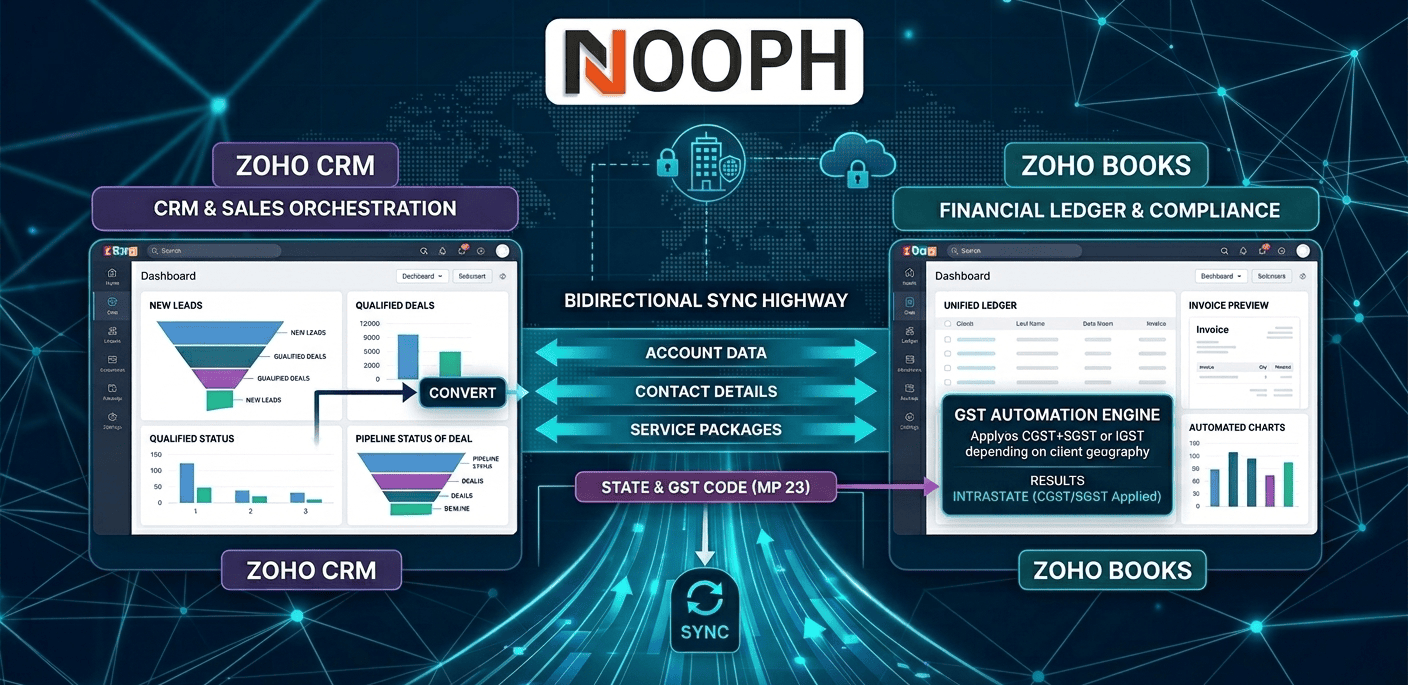
The Resolution: Engineered a declarative-first, bidirectional data highway integrating front-office pipeline management with a back-office financial ledger utilizing the Zoho One ecosystem.
2. The Operational Friction (The Problem)
Before this structural deployment, front-office sales operations and back-office financial accounts existed in siloes. This fragmentation introduced three core business risks:
Data Redundancy: Sales representatives manually captured corporate details in CRM, while finance teams manually re-entered the exact same metadata into accounting platforms to issue invoices—leading to severe dual-entry errors.
Tax Compliance Exposure: In the multi-state Indian corporate landscape, applying incorrect tax brackets (CGST + SGST vs. IGST) on invoices results in major auditing vulnerabilities. Without strict structural integration, billing teams frequently miscalculated cross-border consulting services.
Pipeline Stagnation: The time gap between closing a consulting deal and manually spinning up an invoice delayed the "Time-to-Cash" metric, impacting corporate cash flow.
3. The Structural Resolution (The System Design)
We deployed a code-free, declarative-first Lead-to-Cash architecture built on strict data segregation and automated synchronization boundaries:
Key Architectural Pillars:
Data Segregation (Triage Layer): Unverified inbound traffic from website webforms and social media integration is locked securely inside the Leads Module. This isolates junk or cold data from the core accounting system.
The Master Source of Truth: Upon successful project qualification, a Lead is converted into a verified Account. This conversion automatically locks in the corporate entity name, PAN, and active GSTIN.
The Bidirectional Integration Highway: We configured a live sync bridge between Zoho CRM and Zoho Books. Using an "Overwrite" synchronization protocol, CRM remains the single master database for client profiles. Any live update to a client’s phone number, address, or tax registration instantly mirrors across the financial ledger.
4. Engineering Tax Automation for Indian Compliance
A primary win of this design is the structural handling of state tax jurisdictions based on the physical point of service delivery:
The Configuration: The financial ledger's state engine was anchored to the core operational GSTIN registry (Madhya Pradesh).
Automated Tax Triggering: By precisely mapping the CRM Billing State field straight into the financial engine's core tax module, the system automatically runs a dynamic regional check on every invoice:
Intrastate Invoicing: Client State = MP ➔ Auto-applies CGST + SGST.
Interstate Invoicing: Client State $\neq$ MP (e.g., MCA office in Maharashtra) ➔ Auto-applies IGST.
Corporate Visual Separation: To ensure 100% legal compliance, the system separates tax computing boundaries from legal corporate formatting. While tax automation runs on the active operating state, the formal Ministry of Corporate Affairs (MCA) registered office data is declaratively hardcoded directly into the Invoice Layout Footers.
5. Enterprise Business Outcomes (The Results)
0% Duplicate Entry Friction: Sales transitions to finance natively without a single line of text being copied or pasted.
Absolute Tax Precision: 100% accurate, audit-ready GST calculation enforced automatically via data-field mapping rules.
Accelerated Time-to-Cash: Invoices can now be compiled and dispatched immediately upon pipeline closure, drastically optimizing working capital flow.